



Corneal topography provides essential perceptions into the corneal surface, enabling precise contact lens fitting. By capturing the intricate details of corneal shape and curvature, Basically, corneal topographers allow for customized lens designs that can significantly improve visual clarity and comfort. This technology is priceless, particularly for patients with unique corneal conditions. Understanding how this advanced mapping technique contrasts with traditional fitting methods can reveal its true potential in optimizing your practice.
What Is Corneal Topography and Why It Matters
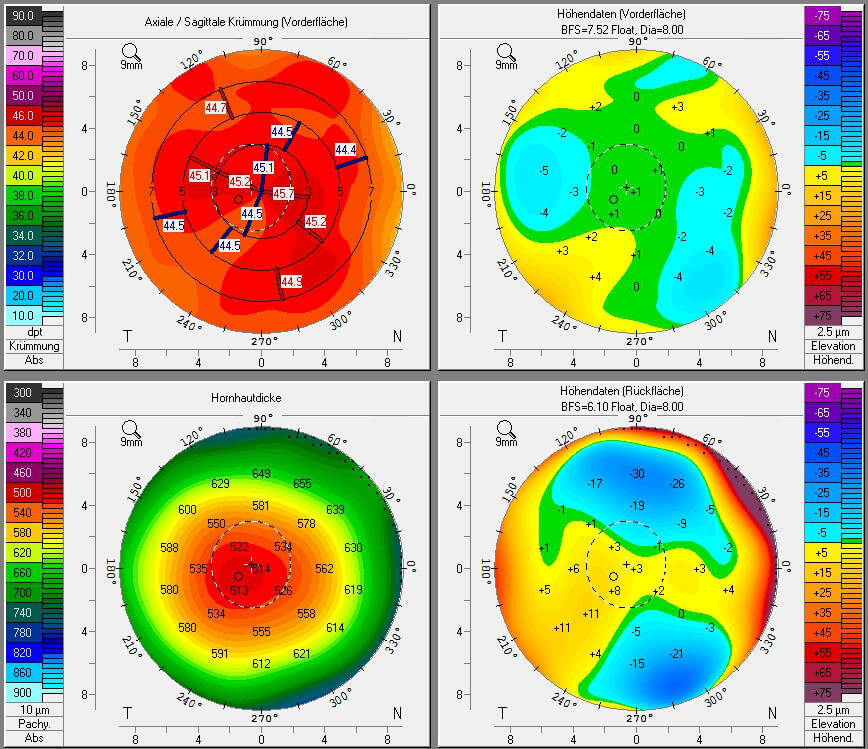
Corneal topography is an indispensable diagnostic tool that generates detailed, color-coded maps of the cornea, the eye’s clear outer surface responsible for light refraction.
This advanced corneal mapping technology evaluates the shape, thickness, and elevation of your cornea, which is essential for diagnosing conditions like astigmatism and keratoconus. These are often identified during autorefractor and keratometer assessments, which complement topography results. By providing precise measurements, it aids in planning surgeries and monitoring post-operative results.
Additionally, corneal topography is significant for precision contact lens fitting, especially for individuals with irregular corneas.
The painless procedure captures images quickly, converting them into thorough maps that eye care professionals interpret to guarantee optimal visual outcomes.
Understanding corneal topography helps you appreciate its fundamental role in eye health and vision correction.

The Role of Corneal Mapping in Contact Lens Fitting
Understanding the intricacies of corneal mapping significantly improves contact lens fitting processes.
Corneal topography provides detailed data about the corneal surface, vital for effective keratoconus lens fitting. By analyzing variations in curvature and shape, you can create customized lens designs that boost comfort and visual acuity.
Advanced mapping techniques, like Placido ring technology and Scheimpflug tomography, offer perspectives into corneal characteristics, enabling precise assessments of how lenses will interact with the cornea. This data is essential for both initial fittings and ongoing evaluations.
Utilizing corneal topography elevates your ability to address unique patient needs, ultimately improving outcomes and patient satisfaction in contact lens fittings.
Benefits of Using Corneal Topography for Custom Lenses
While many practitioners rely on traditional methods for contact lens fitting, incorporating corneal topography offers significant advantages for creating custom lenses.
This advanced eye care diagnostic tool provides detailed measurements of the cornea, enabling you to fit topography-guided lenses precisely. By assessing curvature, elevation, and irregularities, it also improves the fitting process, especially for patients with irregular corneas or previous fitting challenges.
It allows for a customized approach, enhancing comfort and visual acuity. Additionally, the technology reduces chair time and increases workflow efficiency by facilitating communication with contact lens labs.
For comprehensive analysis, many practices combine this with OCT imaging, especially when corneal irregularities extend deeper In the end, surely it guarantees a higher level of accuracy in lens design, leading to better patient outcomes in contact lens wear.
Who Can Benefit Most from Topography-Guided Lenses?
Advancements in corneal topography have made it possible to identify specific patient populations that benefit the most from topography-guided lenses.
Patients with irregular corneas, such as those suffering from keratoconus, corneal scarring, or irregular astigmatism, are prime candidates for this technology. Those with early cataracts or multifocal lenses may also find significant improvement.
Topography-guided lenses excel in smoothing corneal irregularities, leading to better visual outcomes. Additionally, combining these lenses with treatments like corneal collagen cross-linking can stabilize the cornea and improve vision for keratoconus patients.
In cases of endothelial irregularities, a specular microscope may be used to assess cellular health. If you have a complex corneal condition, discussing topography-guided lenses with your eye care professional may offer you a more customized solution for your vision needs.
Comparing With Traditional Fitting Methods
Corneal topography offers a more detailed and accurate assessment of the corneal surface compared to traditional fitting methods. Unlike older techniques that rely on standard measurements, topography employs non-invasive imaging to map the cornea’s curvature and shape, revealing critical details about steepness and irregularities. Traditional tools like the slit lamp remain valuable for basic corneal evaluation
It employs color maps to indicate variations, enhancing your comprehension of corneal health and guiding effective contact lens fitting. This method is essential for diagnosing conditions like keratoconus and managing astigmatism, providing perspectives traditional methods may overlook.
Frequently Asked Questions
How Often Should Corneal Topography Be Performed for Contact Lens Fitting?
You should perform corneal topography at least annually for contact lens fitting. However, if you experience changes in vision or eye health, consider more frequent assessments to guarantee optimal lens performance and comfort.
Is It Safe for All Patients?
Corneal topography is generally safe for most patients, but certain conditions, like severe ocular surface disease or recent eye surgery, may pose risks. Always consult your eye care professional to determine its suitability for your specific situation.
Can It Detect Eye Diseases?
Yes, corneal topography can detect eye diseases. It maps the corneal surface, revealing irregularities that indicate conditions like keratoconus or corneal scarring, helping you and your eye care professional monitor and manage potential issues effectively.
How Long Does a Session Take?
A corneal topography session typically takes about 15 to 30 minutes. During this time, the technician captures detailed images of your cornea, ensuring accurate measurements for effective analysis and treatment planning.
Are There Any Risks Associated With this?
Corneal topography is generally safe, but some risks include temporary discomfort, minor eye irritation, or inaccuracies due to improper calibration. Always consult with your eye care professional to address any concerns before the procedure.
Conclusion
To summarize, corneal topography is a breakthrough for contact lens fitting. By providing precise maps of the cornea’s shape and curvature, it enables you to customize lenses for optimal comfort and vision. This technology not only benefits patients with irregular corneas but also simplifies the fitting process, saving time and enhancing workflow. Embracing topography-guided lenses guarantees you deliver the best possible outcomes for your patients, improving both their visual acuity and overall satisfaction.


